No sentence I write will ever be enough. No words can truly describe what I just felt—what I just lived through. My heart is broken, my mind is scattered, my words are failing me.
Writing this has been impossible, for no word I write is enough.
I could write about the fear that haunted my body since the moment I woke up to sirens on October 7th. How the word ‘fear’ doesn’t feel strong enough.
I could write about how difficult it was to process that missiles were headed straight towards me as I stumbled out of bed. How I only had a minute and a half to get down 3 flights of stairs to the bomb shelter. How we could hear the booms of every missile, intercepted or not.
I could write about the utter shock I felt as I waited out my first rainstorm of missiles in the shelter. How I stood there trying to wake up and wrap my head around all of this. How I started to read the news saying this time was different—unprecedented. How dozens of terrorists infiltrated villages, apartment buildings, and family homes in the south, and were currently murdering and kidnapping anyone in sight.
I could write about my total disbelief as I read that they were still there—and even more continued to come through the border. How I couldn’t fathom that they were still going door to door and taking entire buildings hostage. How I couldn’t help myself from calculating how long it might take for them to get to Tel Aviv. How on any other day, the south feels so far, but on that day, a few hours drive didn’t feel far enough.
I could write about every single “you okay?” text I sent and received. How every single time there was a delayed response, it was hard to breathe. How I realized a friend of mine was on the army base that was attacked. How I didn’t know if she was safe until the following day.
I could write about how I thought the news of this massacre against innocent civilians must be the worst thing I had ever heard. How I thought it was so horrible, so cruel, and yet I had no idea that we hadn’t even heard the worst of it.
I could write about how I was in such a state of shock that first day, I couldn’t even cry.
I could write about my 5th trip down to the shelter on the first day. How even when I was pretending to be strong, the worry was written all over my face. How my neighbor tried to calm me when we heard more booms than usual. How I remember him reasoning with me, “The Iron Dome is so good, you don’t need to worry,” he said, “Especially in Tel Aviv—the rockets never land in Tel Aviv.”
I could write about how we walked out of the shelter 20 minutes later to the smell of smoke in the air, learning that two rockets had just hit Tel Aviv. How one of them hit an apartment building on my friend’s street and another in the neighborhood next to mine, both places a short 15 minute walk away.
I could write about going back to my apartment in shock, not caring that I burned the dinner I was cooking before the siren went off. How it didn’t matter—I had no appetite anyways.
I could write about how reluctant I was to call my family, knowing this would be the straw that broke me. How I knew if I called them—if I heard their voices—it would break me. How all I wanted to do was to calm their fears, but all I needed was to voice mine.
I could write about my honest and raw confession to myself that first night—how the unprecedented nature of this attack, and the fact that the border was still open, left me wondering if I would survive this. The uncertainty of it all had me truly terrified that I would never get to see my family again.
I could write about how the realization hit me like a tidal wave—that just became true for hundreds of people. No warning, no goodbye. Just a completely devastating loss.
I could write about calling my brother that first night and losing it. How my first tears of what would be millions finally escaped.
I could keep writing about October 7th, and it will never be enough. I could write and write and write and I would never be finished. Nothing could even come close.
I could write about how I felt on October 8th, too, though these words will never be enough.
I could write about how I heard story after story of the victims, and my heart impossibly broke more. How people kept posting the numbers that wouldn’t stop rising: X killed, X injured, X kidnapped, X missing. How my frustration grew because numbers don’t do a person’s life story justice. How I thought of 500 people—500 individual human beings with their own personalities, their own loved ones who can’t imagine life without them, their own plans for the future that should still lay ahead of them.
I could write about how I didn’t think my heart could take anymore. How it wouldn’t stop breaking over and over and over.
I could write about the love I’ve always had for the desert—the same desert that just became the site of a massacre. How I was always comforted by it being so remote and quiet and peaceful. How I had just gone camping in that very same desert, not too far away, a few weeks ago. How I know that there is literally nowhere to run, nowhere to hide, nowhere to go. How I cried for how helpless they must have felt.
I could write about how I will never see the desert the same.
I could write about how small this country is. How easily the victims of this massacre could’ve been a friend, a colleague, someone I met at a bar, or went on a date with, or chatted at a cafe with, or shared a laugh with, or listened to play music on the street, or…
I could write about how this is the current reality for most Israelis.
I could write about how I still feel such profound sadness and loss, whether I knew them personally or not. How these are our people, the souls of our nation, the ones who make up our community. How they make our home, home.
I could write about how I know I will never be the same. How the world will never be the same. How my home will never be the same.
I could write about feeling a complete loss of hope that the world is good, or that good will prevail over all evil. How I’ve never seen such deep-rooted cruelty and inhumanity so closely, so intensely, before. How now that I’ve seen it, I will never be able to forget it.
I could write about how much I wish I could unsee it all. How I wish I could unsee the woman my age, dragged through Gaza by her hair; naked and unmoving. How I wish I could unsee that little boy, kidnapped and pushed around by Palestinian children like he was a toy. How I wish I could unsee another girl begging for her life. How I wish I could unsee the mothers arms clutching onto her children as they are taken away.
I could write about how the attack was so unfathomable—so utterly terrifying—that my sense of security had left me completely. How the one place I have always felt most safe to live my life completely and truly, suddenly felt like the most dangerous place I could possibly be.
I could write about sobbing for hours on end, alone in my apartment. How I wished more than anything, to be able to cry with the comfort of my mom’s arms around me. How I wished she could just hold me and protect me as I tried to process it all. How I had never hated living alone until that very moment. How my mind just kept fearing the worst, no matter how much I tried to stop it.
I could write about how I had no clue what the next day would bring, or even the next hour.
I could write about October 9th, too, but words do not do it justice.
I could write about how I was paralyzed with fear. How it felt like the room was closing in on me when I learned that they started attacking from Lebanon, too.
I could write about how each notification on my phone left me more frightened, more broken, more paralyzed. How my phone kept dinging; rockets in the south, rockets in the center, terrorist infiltration from the south, terrorist infiltration from the north, terrorist infiltration from the east.
I could write about how it got even worse. How with every hour that passed, more people were added to the list of victims. How with every minute, it seemed like they uncovered new methods of torture that only the most vicious, inhumane evil could ever come up with. How they didn’t just write about it, they recorded it. How I couldn’t fathom a human being capable of any of it.
I could write about how my mind played an endless loop of the worst possibilities for the future. How terrified I was knowing that the evil we saw in the south would come for more blood if given the chance. How every single noise had me questioning if I was next.
I could write about crying and crying and the tears never ending. How the sobs shook through my body harder than I’ve ever felt in my life.
I could write about my fear for my own life, my fear for my friends’, my fear for my country, my fear for the soldiers protecting us.
I could write about how everything just felt unbearably terrifying and all I could bring myself to do was sit there in my fear.
I could write about how I haven’t been able to breathe properly since I went to sleep on October 6.
I could write about all of it, and it will never be enough. I could write and write and write and I would never be finished.
No matter how many details I use to describe how I didn’t just hear the booms, I felt them,
No matter how explicitly I describe the sobs that wouldn’t stop raking through my body,
No matter how meticulously I express the devastating loss of human life,
No matter how clearly I recall how much I feared for my own life,
No matter how long I write about the lifetime that was these last few weeks,
No matter how much of my heart is pouring onto this page,
Nothing I write will ever be enough.
As I read this back to myself, I think of more details, more pain, more memories that portray what it was like for those few days. But to what end? No word I write will ever, ever be enough.
—
I write this knowing I’m lucky. I’m lucky to have been in Tel Aviv. I’m lucky that everyone I care about is safe and alive. And if this is what it feels like to be lucky…my heart is in pieces over everyone who wasn’t.
—
The people we lost on October 7, and every day since then, will never be forgotten. This country, this community, will feel their loss deeply, forever.
Before 23, I really thought I knew who I was. Now, however, I’ve come to realize that person was almost entirely made up of pressure and expectations–from myself, my family, and the culture I grew up in. I used to be so overcome with anxiety that I constantly had my guard up, hoping that nobody could see the real me–the real, imperfect me.
I was so scared of rejection and shame that I buried my true self so deep down, I lost her. I don’t think I ever even had the chance to know her.
Somehow, moving away helped me leave behind a lot of these pressures. Maybe it was the change of environment, the timing, or the very authentic, expressive nature of Israelis inspiring me. Whatever it was, I finally felt a release from the loop of anxiety, fear, and disconnectedness.
So, what do I mean when I say I met myself for the first time when I was 23?
I mean that, for the first time ever, I’m letting myself just be. I’m releasing the pressure to show up or act a certain way–no longer hiding my thoughts, my feelings, my self.
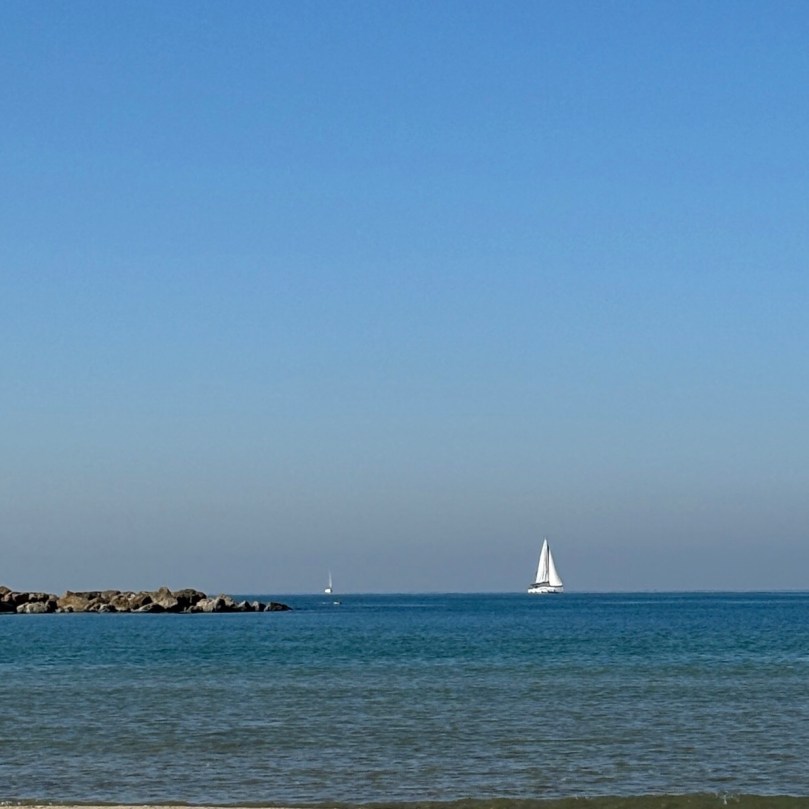
I sit by the sea every Saturday now. I sit there and I just watch the waves crash towards the shore. I use them as a guide, as I learn to let my thoughts come and go, too.
I let my intuition guide me. I listen to my needs. I validate my emotions.
In doing this, I meet myself. I sit with myself. I reflect with myself. I learn from myself. I heal myself.
These moments of stillness and acceptance show me who I truly am.
Fully accepting–and learning to love–myself when I’m alone trickled into my relationships, too. It’s allowed me to finally lower the mask I always hid behind and close the distance between myself and the people around me. I started showing up as the emotional, open-hearted, authentic, still-imperfect-me.
I showed up as me and instead of fearing rejection, I thought, What if people actually like the real me? How incredible would that feel?
There is so much in this world to be grateful for, and yet we are fundamentally built to focus on the negative. To protect ourselves, we focus our energy on what went wrong, what we don’t have, and what we wish were different. We are conditioned to have these negative mindsets, and yet, by doing so, we lose out on so much beauty and magic that the world has to offer.
Gratitude is how we bring magic back into our lives. For everything in your life you can complain about, I promise you–there are 100 things to be grateful for. I think about my apartment: a tiny studio on a very loud street, and yet I love this apartment so much. Yes, it is so small that my kitchen, bedroom, and living room are one. Yes, the kitchen is difficult to cook in because of the size. Yes, I can hear construction every morning and the neighborhood cats fighting every night. Yes, there are a bunch of other issues that I could easily complain about, but I don’t.
I don’t complain about it because I choose to focus on what I’m grateful for. I am so grateful that my apartment is small because it makes it so easy to clean. I am so grateful to be able to cook my own meals in my own space–even if that space is tight. I am so grateful to be a heavy sleeper, because once I’m asleep the noise doesn’t bother me. I am so grateful to have a place to live–a space that is entirely my own.
Sometimes, I can even find ways to laugh at the problems. Now, every night when I hear the cats, I imagine them having a meeting and discussing something “serious”. I really have no idea why I started doing this, but now instead of getting annoyed when I hear the cats, I simply laugh–and I’m grateful for them bringing me joy.
This is a relatively easy example, but the magic of gratitude is truly put to the test when facing problems that are much bigger or more difficult.
I often feel like there is a misunderstanding of what a life of gratitude means. Sure, sometimes living a life of gratitude means tearing up at the beauty of the sunset, or truly thanking loved ones, or saying a blessing over your food, or the apartment example I just mentioned; but what people often neglect is the bigger picture. Living life with gratitude isn’t just about acknowledging what you have; it’s also about finding meaning in the hard times.
Gratitude has taught me to look at challenges from a different perspective. Instead of thinking about how I wish things were different, I look at how a hardship can teach me an important lesson, make me stronger, or show me an opportunity I otherwise wouldn’t have seen. Often, when we are faced with something difficult, it is because of that challenge that new doors open, or we finally see things from a new perspective–propelling us forward. All of this is true, and yet, when we’re stuck in the moment, it’s difficult to practice gratitude in the traditional sense.
Sometimes it’s hard to be grateful for a challenge in the moment because we still don’t know what good will come of it. In order to get myself out of the negative headspace and into a place of gratitude, I think of something in the past that felt impossible. Something I never thought I could get through, or a challenge that seemed like no good could ever come of it.
I think of all the times I have felt so low, only for the light to come in shortly after. This is where I focus my gratitude–the light after the darkness. I have gratitude for the proof that good things come after hard things. It doesn’t mean you have to be glad something happened, because some tragedies are simply painful. It’s difficult to be grateful for those painful moments, but even in the deepest darkness, we can find a little glimmer of light if we try.
When I think back on the toughest challenges I’ve faced in my life, I have immense gratitude for them. They showed me who I am and who I want to be. They showed me that I can do hard things and come out better because of them. They brought me to where I am today.
Next time you are faced with something difficult, I challenge you to use gratitude to get through it. Gratitude for the strength your past has given you. Gratitude for this challenge–whatever it may be–because one day you will be able to look back and say, I didn’t think I could do it, but I did.
We are capable of so much more than we think we are. We just have to open our hearts and our minds to the magic of gratitude–and have a little faith that we are exactly where we’re meant to be.
I have to give a lot of credit to the book that opened my eyes to the magic of gratitude — TheMagic by Rhonda Byrne. It changed my life (and it can change yours too).
I like to think I enjoyed school throughout my life, but what I really liked was what school did for me. I know I was never the smartest student in the class, but my grades were good enough to get recognition. I used my academic accomplishments to validate that I was not just smart or successful, but that I was good and worthy. Year after year, I buried my insecurities and anxieties in A’s and academic excellence awards.
It’s been over a year since I graduated from my university, and I still struggle with the loss of my academic identity. Academics always provided a great distraction from my insecurities. It gave me a certain amount of control over how people viewed me. I used my grades to prove my worthiness, my capability, and my intelligence; and I was pretty good at it.
Upon graduation, however, that identity quickly slipped through my fingers. I finished school and decided not to pursue higher education (for now). Instead, I did something I never thought I would and moved across the world to get a part-time teaching job. In this role, I was average.
I was average, and I was okay with it because I saw it as a gap year-–a break from proving myself. It didn’t matter what my job was because I had a different focus; living and learning about a new country and culture. It didn’t matter if my job was impressive because the simple fact that I was living here was. And it was only supposed to be temporary.
Now that I made aliyah, however, I’m searching for a “real job” in the “real world,” and those feelings of inadequacy and anxiety have started to resurface–but this time, I don’t have academics to hide behind.
Instead, I’m facing these feelings head-on as I navigate my way into the Israeli workforce.
It’s both frustrating and humbling looking for a job when I’m not fluent (or even intermediate) in Hebrew. My options are limited to mostly entry-level positions in specific fields where they want English speakers. It’s difficult to accept that the positions I thought I would go for post-college simply aren’t available to a non-Hebrew speaker here.
I feel my anxiety beginning to resurface, but this time it’s zeroing in on job titles instead of grades. I keep searching for a position that seems impressive and proves my intelligence to others. I’ve worked hard my entire life to build this identity, and clearly I’m having trouble letting it go.
It’s hard to let go, but I’m working on it.
The first step is recognizing when these insecurities start to surface. Next, I try to really think about why a job title feels so important to me (and it usually has something to do with wanting recognition from others). At this point in my life, I know wanting recognition from others comes from the deep-rooted belief that I’m not good enough–or worthy enough–without it. I try to gently remind myself that I am good and worthy and smart no matter what title I hold, or what recognition I receive. I recognize that I am only trying to gain external validation to heal internal wounds.
I’m also trying to focus on how losing my academic identity created space for something new. Maybe this rigid identity isn’t meant to be replaced by another temporary solution (like an impressive job title). Maybe it’s actually meant to simply be freedom–freedom to let myself wander and grow and experience life for what it is, rather than what I think it should be. I am trying to build a life for myself with meaning and fulfillment, and I have to accept that it just might not look like the conventional vision of success.
I’m trying to give myself some grace (and have some humility). I just moved to a foreign country where I don’t speak the language very well. I’m trying to accept that it’s going to take patience and hard work to find a job that brings meaning and joy to my life in the way that I’m looking for.
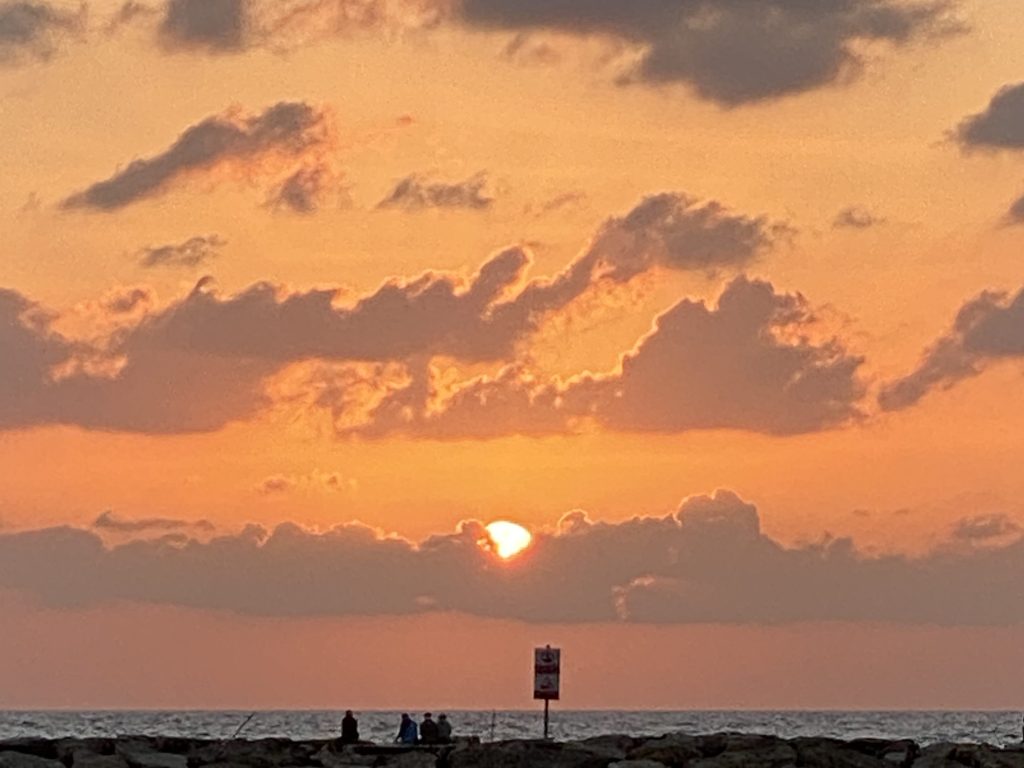
Until I get there though, I’m working on filling this space with more things that heal my heart. I’m going to keep writing, painting, watching the sunset, practicing Hebrew, reading, doing yoga, and developing my relationships with people that bring light and goodness into my life. It won’t magically fix all of my insecurities or fears, but I think slowly, piece by piece, it will show me who I am behind the grades and accolades. Who I am when I am just as good and worthy and intelligent as I was when I was a student. Who I am when I am just myself.
My hope is for this blog to become a place where we grow together–instead of me simply writing into a void. In order to create that community, I invite you to scroll to the bottom of this page and comment any reflections you have (commenting and liking on here helps my website grow and reach a wider audience, which is really cool!).
If you don’t feel comfortable sharing publicly, of course, you can also message me privately as usual.
So, in the comments, I’d love to hear more about what identity(s) you are holding on to. How might it be holding you back (or pushing you forward)?
After being in New York for a few months, I felt so disconnected from my life in Israel that I seriously considered just staying home. I could barely even remember why I wanted to return. Of course I knew, but I just didn’t feel it the way I thought I would. I thought I would get sick of being home, itching to come back, with no doubt that this was the right decision. But I didn’t want to leave. How could I after realizing everything I missed while I was gone?
When I thought about staying in New York, however, one feeling remained strong in my memory: the complete and utter sadness I felt over the thought of leaving Israel just a few months ago. When I remembered that, I knew I owed it to myself to see this through.
So, despite the pit in my stomach at the thought of leaving my family and friends once again, I did it. I got on the flight and landed in Israel as an Olah Hadasha (new immigrant).
Now I’m back in Tel Aviv, and–sorry Mom, cover your ears (or eyes)–I immediately remembered all of the reasons why I love it here; why I was so excited to not just move back here, but to make aliyah (become a citizen). For a while, I forgot how much this place felt like the most challenging and rewarding and beautiful home I’ve ever known. I feel lighter here–happier. I can’t explain how, or why, but I do.
And somehow it’s like I never left. The place I had grown to know and love had waited for my return and embraced me with open arms. Strangers on the plane, the beach, and even the woman I bought a toaster from on Facebook marketplace, offered to help in my job search and invited me to Shabbat dinners. This was the Israel I couldn’t imagine leaving a few months ago. The place that feels like home even when I’m surrounded by people I don’t know, speaking a language I only barely understand.
The first morning I woke up in my own apartment, I couldn’t keep the smile from my face. I was back in the city I love, living by myself, about to create a life that is entirely my own. My gratitude for this was ever-flowing.
I felt a sense of inner peace I hadn’t felt in a long time–since the last time I was here, probably. It’s the kind of inner peace that lets me know everything will be okay because I am exactly where I’m supposed to be at this moment in time.
I talk about this inner peace even as I recognize how I felt in New York–that I was happy there too. Happy in a different way, but happy nonetheless. I felt happy in a comfortable-and-familiar kinda way. I was glad to be with family and old friends, but I couldn’t help feeling like something was missing. But here, in Tel Aviv, I feel happy in a passion-and-excitement-about-life kinda way, and, frankly, that’s what I’m after.
It’s a hard pill to swallow that this is where I feel my best right now, because wouldn’t it just be so much easier if I felt happier where my roots are? There are things about New York and people there that I love too, but for some reason Tel Aviv is just where my soul comes alive. I think I felt so lost while I was home because I wished that following my heart didn’t mean leaving everything else across the world. But alas, here I am across the world, and so far it feels pretty spectacular to be back.
Two weeks ago I wrote a draft that was so depressing I cried every time I tried to re-read it. Frankly, it was less of a draft and more of a brain-dump. I poured every single sad thought I’ve felt these past 2 months at home into a google doc page in about 10 minutes.
I wasn’t even processing as I typed. I just let it out, typing as the tears rolled down my cheeks. When I finally finished, I reread it once and started crying harder; so I did what any normal person would do and shut my laptop for days, refusing to read those words again. But I knew it then just as I know now, I was about to face the feelings I had buried since landing in New York.
Nobody really warns you about how difficult it is to come back home after being gone for an entire year. Well actually, that’s not true. They warn you about “culture shock” and “re-entry”, and those are both very real–but those were the least of my problems.
The hardest part about coming home for me was finding that the people and places that once felt so familiar become somewhat foreign in the blink of an eye.
When I came back, I expected things to be the same (more or less), but, wow, a year is a long time to be gone. What I initially thought was just sadness about an incredible year abroad ending turned out to be so much more than that. I found that a large part of me was actually grieving the loss of the life I had at home before I left. The life that wasn’t patiently waiting for me to return while I was away.
When I first came home, I felt completely and utterly alone. I thought nobody could possibly understand what I was going through. Plus, not only had I changed a lot this past year, but so had almost every single other person in my life. I felt like I no longer fit into anyone’s routines. I felt like I didn’t even know these people anymore (the new versions of them, at least). Mainly, I felt like my home—the place that was supposed to always accept me and comfort me—was rejecting me.
This past year, I had been so wrapped up in my life on the other side of the world, I hadn’t realized just how much changed in my absence. I know it sounds ridiculous because of course I know life goes on, the world doesn’t revolve around me, blah blah blah. I know that, but life doesn’t just go on. People don’t just change a little bit in a year, they transform.
When I was finally ready to re-open my laptop and face the words I left on that page, I began to realize why I was so uncomfortable. So sad. Overwhelmed. Conflicted. I came to understand that my home wasn’t, in fact, rejecting me. For the first time, I was just truly confronting the reality of moving so far away from home. The reality that no matter how much I call and FaceTime, I still wasn’t there.
I missed a lot–but I didn’t just miss birthdays, holidays, or even special events like my brother’s graduation. I missed out on the little things that are actually really big things; like family dinners or late night talks on the couch. I missed the ways people subtly change over time, like my brother starting to mature and build his confidence, or my sister healing and becoming really happy, or my family slowly grieving and healing after my grandpa’s passing. I missed so much and it feels impossible to know all of this and just accept it.
—
Since writing that first draft, I’ve done a lot of “soul-searching”…if you want to call it that. As it turns out, my version of soul-searching is crying a lot and questioning everything—including my own sanity. Thankfully the tears have (somewhat) slowed and I concluded that I am a (somewhat) sane human being.
The funny thing is that once I finally processed what it meant to “come home”, I was able to see how many of these changes were actually good. Even if I wasn’t there to witness these changes gradually, there’s also some beauty in getting to see how much progress someone has made so clearly–a perspective I had only because I lived far away.
Since confronting my feelings, I also took it upon myself to finally stop moping and make the most of the time I have left before I leave again. Pushing people away and avoiding my feelings wasn’t making things better in the slightest. So now I’m making more of an effort to show the people I love that I want to be a part of their routines, I want to see and embrace the ways they’ve changed. It’s not easy, but it helps.
And just like that, home is feeling a bit more like home again.
Thank you for the friendships. The laughs, the trips, the nights out, the beach days, the many, many meals eaten (and cooked) together. It’s so beautiful to think that although we came from all over the world, we somehow ended up here, together. Thank you.
Thank you for broadening my perspective on what it means to be human. Leaving the American bubble of politeness, individualism, and so-called “perfection”, and diving into this brutally honest, emotional, and tough country showed me a side of humanity I had never seen before. A community where neighbors truly help neighbors; not because it’s expected of them, or because they want help in return, but because they just care for one another. It’s a culture that seems to create this norm effortlessly. I have learned so much about vulnerability, self-advocacy, and what it means to be a part of a real community by immersing myself into it. Thank you.
Thank you for reconnecting me to an old friend. Losing touch with someone who once felt like family is rough, but you brought him back into my life at the perfect time. Not only as a friend, but as a roommate who took me in when I really needed it. He was a piece of home when home was 5,000 miles away. Thank you.
Thank you for the spiritual awakening. At the start of this year, I was craving spirituality in my life, but I had no idea how to go about cultivating it. You brought me the right people to learn from, talk to, and get inspired by. I can honestly say I have never felt more connected to G-d than I have this past year, and, consequently, I have never felt more strength and hope to now continue on to whatever the future holds for me. Thank you.
Thank you for bringing me a love that is kind and pure. A love that makes me feel comfortable, excited, happy. Falling in love with him is a gift. Thank you.
Thank you for everything; the good times and the bad. They brought me here, so grateful for this life, this country, this past year. It’s been a wild ride, and yet I have a feeling our adventures together are just beginning.
I have simply loved this past year with you—so much that I just can’t leave for good. So don’t you worry, I’ll be back.
Sincerely,
A Girl Who’s Aliyah Paperwork Can’t Get Processed Fast Enough
Is it still the Bat Yam Yoman if I don’t live in Bat Yam anymore?
Yep, it’s true; I moved. I moved out of Bat Yam and into Tel Aviv in May. While this was always the plan I had for after my program finished in July, I ultimately moved earlier than I had anticipated.
There were many factors that led to my decision to leave my apartment in Bat Yam. I knew that when I faced my feelings and contemplated my options, moving was the only true solution for me, yet I still struggled to accept that this is where this situation had brought me.
My decision to leave a situation that was, from my perspective, toxic and unhealthy, was difficult. Accepting that friendships that once felt like family had evolved into something that left me feeling alone, anxious and unhappy is no easy pill to swallow. Not just because of the obvious hurt that occurs in the present when a friendship turns sour, but because it begins to taint all the memories you once had with those people–even the good ones.
With time, space, and a new perspective, I can now recognize that despite the sad ending, I still have a lot of gratitude for these friendships. They brought me some really great times and, in the end, I learned a lot. I also learned to accept that some people just aren’t compatible with each other and that’s okay.
I learned that true, lasting friendships can’t happen with just anyone. Trust and strength and love don’t simply appear instantly with people because I want them to, or because I feel alone, or because we spend a lot of time together.
I read a quote somewhere that compared people to anchors and engines. The analogy explains the different types of people we can have in our lives; someone can be an anchor (meaning they hold you back or keep you stagnant), or someone can be an engine (meaning they push you forward–encouraging and inspiring you to grow). Some people might be okay with friends who act more like anchors; it’s comfortable and maybe even easier. But I want more. I want my friends to inspire me to be a better person, not encourage negative and unhealthy behaviors. We are a sum of the people we spend the most time with, so yeah, I’ve become more selective in my friendships.
Ultimately, these really difficult relationships showed me how lucky I am to have the people in my life that inspire me, respect me, and love me for who I am, and I will no longer accept anything less.
After taking a big look at the energy I was surrounding myself with, I just knew I needed to get out of that environment. I realized I have to actively choose the type of person I want to be every day, and that person is impacted by who I spend my time with.
If you’ve ever wanted to see a perfect display of the strength and resilience of the Jewish people, all you have to do is spend a few weeks in Israel during Yom HaShoah, Yom HaZikaron, and Yom HaAtzmaut.
On Yom HaShoah, my Masa program coordinated a day at Yad Vashem, Israel’s Holocaust museum in Jerusalem. We spent the day reading and discussing testimonials written by people who perished in the Holocaust, all of them produced shortly before their deaths. As we made our way through the letters, poems, and pieces of art, I realized there is something so heartbreakingly beautiful about learning about the Holocaust in Israel. So many of the testimonials referenced hopes for the future of the Jewish people, and even a Jewish state. When people knew they would not survive the concentration camps themselves, they were sure that the Jewish people would prevail and eventually find their way back to their home land. It wasn’t lost on me how lucky we are to be here now, actually living out that dream less than 100 years later.
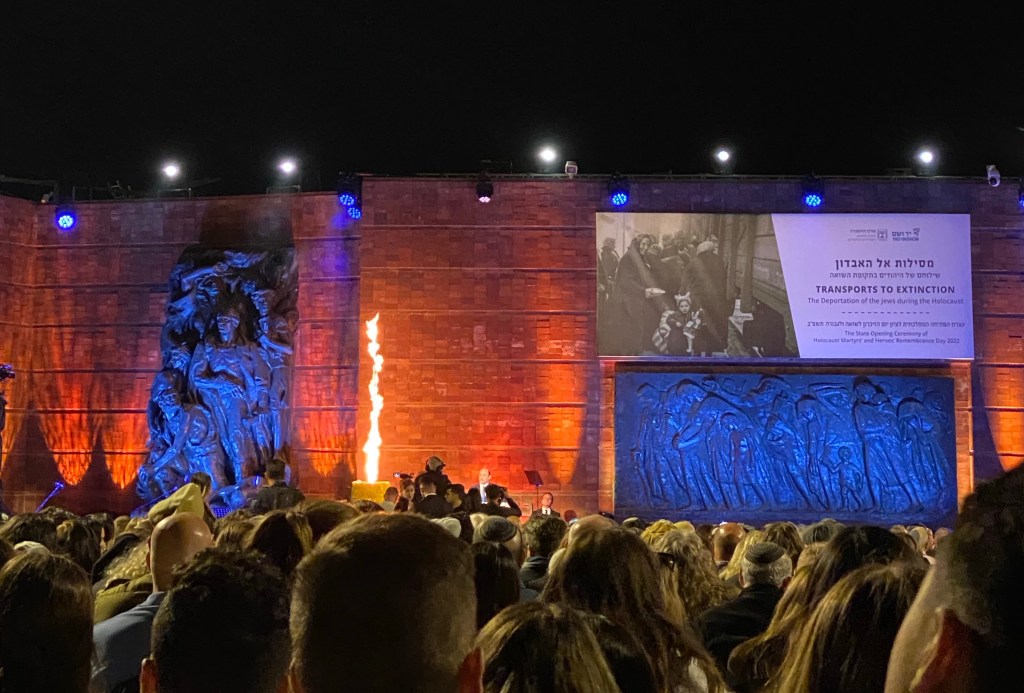
Yom HaShoah Opening Ceremony at Yad Vashem
That same evening, I had the honor of attending the Opening Ceremony at Yad Vashem. In this ceremony, Holocaust survivors and their descenents lit six torches to commemorate the 6 million Jews lost during the Holocaust. As each Holocaust survivor was called up to the stage, the number of children, grandchildren, and even great-grandchildren was announced to everyone in their introduction. It was a beautiful testament to the legacies they were able to create. As the ceremony came to a close, I couldn’t help but feel overwhelmed with emotion as we sang the Hatikva alongside Holocaust survivors, the Prime Minister, the President, Israelis, and Jews from around the world; realizing that after all this tragedy, we are here, standing together in the holy land.
Just one week after Yom HaShoah, I watched as the whole country stood still once again as we mourned the lives lost during military service and terror attacks. We stood together in silence as sirens sounded across the nation in their memory. In a Memorial Day completely different from the US, I realized how deeply each person was affected by loss here. With mandatory military service, the gravity of Memorial Day was truly recognized.
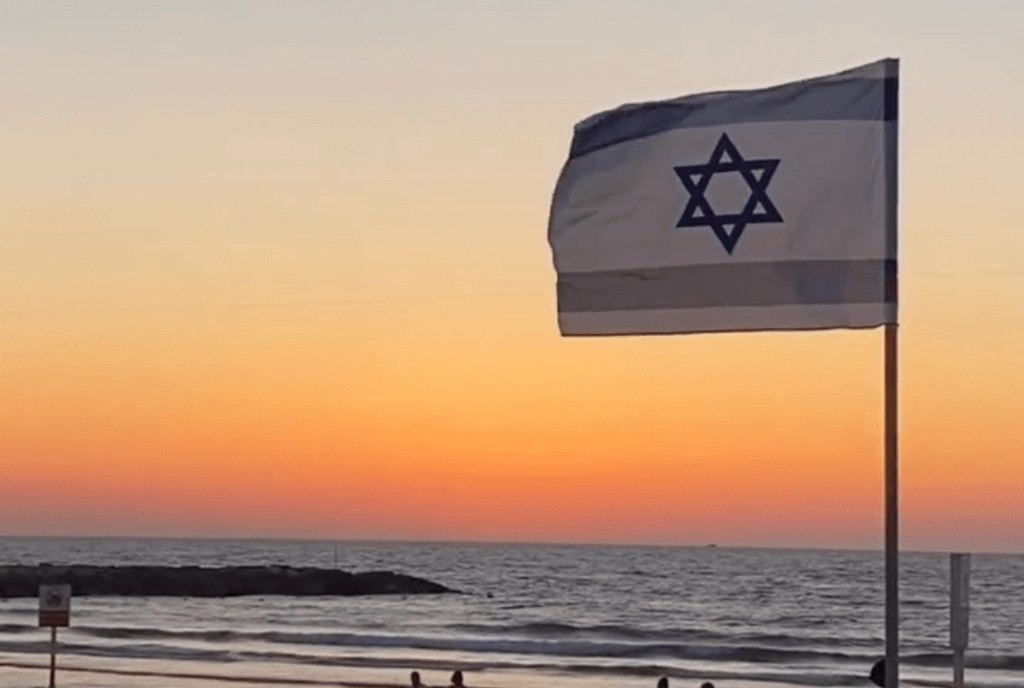
Despite the grief during the day, as the sun set and we moved from Yom HaZikaron to Yom HaAtzmaut, the energy completely flipped. Israel exploded with celebratory fireworks, parties, and barbeques. In a display that only Israelis could pull off so effortlessly, it was evident that despite all of the hardship and all of the pain, Israel is still standing and we must celebrate the life and freedom we are so lucky to have!






 Growing Through.